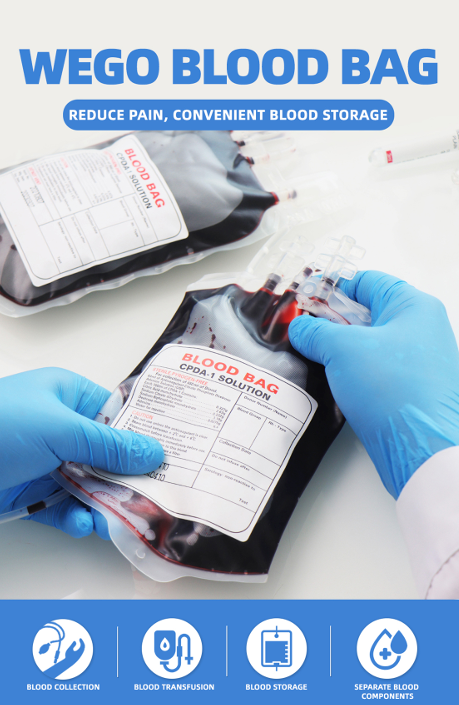


In clinical environments, certain tools form the operational backbone of essential procedures. Among these, the single blood collection bag is a primary example. This specialized

Fast defibrillation, lightweight and compact, all-round protection.
WG012-001
WEGO Defibrillator is an advanced medical device designed for fast and effective defibrillation. Featuring a 4-in-1 mode, it ensures rapid response in critical situations. It is certified according to EN 1789 standards, making it suitable for use in ambulances and emergency transportation.
Compact and lightweight, the WEGO Defibrillator offers enhanced portability without compromising on performance. With two battery capacity options available, it guarantees long-lasting reliability to meet the demands of prolonged use in emergency scenarios.
With an IP44 protection rating, the WEGO Defibrillator provides comprehensive protection against environmental factors. Equipped with multifunctional paddles and advanced BTE technology, it ensures ease of use and efficient operation in life-saving situations.
| Standard Configuration | Manual defibrillation, AED, 3/5-lead ECG, RESP, Thermal Recorder |
| Optional | NIBP, EtCO2, SpO2 |
| Screen Size | 7” TFT screen 800*480 |
| Waveforms | 2 waveforms |
| Power requirement | 100-240V~, 50/60Hz±3Hz |
| 4 in 1 mode, fast defibrillation |
| EN 1789 certified for ambulance and emergency transportation |
| Compact and lighter |
| Two kinds of battery capacity, long lifespan. |
| IP44 protection |
| Multifunctional paddles 1 for 2, advanced BTE technology. |
ICU, NICU |

In clinical environments, certain tools form the operational backbone of essential procedures. Among these, the single blood collection bag is a primary example. This specialized

Consider the intricate journey of a surgical suture, from raw material to a sterile device closing a wound inside the human body. This path is

We recognize that in surgical settings, the success of a procedure extends beyond the operation itself to the materials that support healing. Among these, the

The surgical management of thoracolumbar spinal instability requires a method that can adapt to complex anatomical presentations. This region, serving as a transitional zone between