




Consider the intricate journey of a surgical suture, from raw material to a sterile device closing a wound inside the human body. This path is defined not by preference, but by a rigorous framework of mandatory rules. For any surgical suture manufacturer, adherence to these compliance standards is the absolute baseline for operation and market access. At WEGO Medical, our processes are built around this framework, ensuring every product meets its critical duty.
Adherence to International Quality Management Systems
The foundation of compliant manufacturing is a certified Quality Management System (QMS). Standards like ISO 13485 specify the requirements for a comprehensive system dedicated to medical devices. For a surgical suture manufacturer, this translates to documented procedures governing every single stage: from initial design controls and supplier qualification to meticulous process validation and final product release. This system ensures consistency and traceability. It means every batch of material is recorded, every sterilization cycle is validated, and every non-conformance is investigated. A robust QMS, as maintained by WEGO Medical, provides the structured environment necessary for predictable, high-quality output.
Meeting Regional Regulatory Directives and Clearances
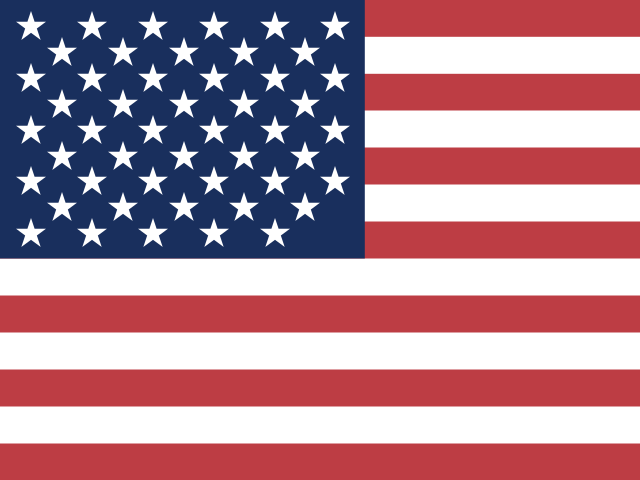
While a QMS provides the operational backbone, market authorization demands specific regulatory compliance. Different regions enforce their own directives. In the European Union, sutures must carry the CE Mark under the Medical Device Regulation (MDR), demonstrating conformity with health, safety, and performance requirements. In the United States, a surgical suture manufacturer must secure clearance from the Food and Drug Administration, typically through a 510(k) submission proving substantial equivalence to a predicate device. These are not one-time achievements but ongoing commitments to post-market surveillance, reporting, and quality audits. Navigating this landscape is a core function of a responsible manufacturer like WEGO Medical.
Validating Material Safety and Sterilization Assurance
Compliance directly intersects with material science and microbiology. Standards exist to prove two non-negotiable points: biological safety and sterility. Testing for biocompatibility—assessing how suture materials interact with living tissue—follows strict ISO 10993 protocols. Furthermore, demonstrating that the chosen sterilization method (like ethylene oxide or gamma radiation) consistently achieves a Sterility Assurance Level (SAL) of 10^-6 is mandatory. This requires exhaustive validation studies that challenge the process under worst-case scenarios. For a surgical suture manufacturer, this scientific validation is the evidence that products are safe for their intended use.
The landscape of compliance is complex and non-negotiable. It integrates management philosophy, regulatory law, and hard scientific validation into a unified control strategy. These standards exist to transform a simple thread into a reliable, predictable medical device. For healthcare providers, this infrastructure provides confidence. At WEGO Medical, viewing these standards not as obstacles but as the essential blueprint for quality is what informs our daily discipline and long-term commitment to the field.